

- Rated 4.9/5 by 11,210+ students
Best Cyber Security Course in Pune with Placement
Become a Certified Cyber Security Professional in 90 Days with hands-on labs, real-world security projects & placement support.
- 8,450+ Students Trained
- Placement Support
- 24×7 Lab Access
- CCIE-Certified Trainers
- Limited seats for next batch · Offer ends this week
Our 11,210+ alumni work at top networking companies


- Officially Accredited
Trained by an EC-Council Accredited Training
Center
I-Medita Learning Solutions is recognized directly by EC-Council, the global body behind the CEH certification — so every lab, module, and instructor in this program meets their
standard for delivering ethical hacking training.
standard for delivering ethical hacking training.

EC-Council Authorized Training Center
I-MEDITA is an EC-Council Authorized Training Center (ATC), delivering official EC-Council certification training, authorized courseware, and professional cybersecurity training services.

Our accreditation certificate
Issued directly by EC-Council, confirming I-Medita meets their standards for delivering official CEH training in Pune.
Certificate ID
EATC48146
Issued
Nov 07, 2019
Valid Until
Nov 30, 2026
- Why Cyber Security?
Cyber Security is one of the fastest-growing IT careers in India
With the rapid rise in cyber threats, every organization needs skilled cybersecurity professionals to protect their systems, networks, and sensitive data. A Cyber Security certification equips you with practical skills required for careers in Security Operations (SOC), Ethical Hacking, Network Security, Cloud Security, and Incident Response.
45,000+
Active Cyber Security job openings across India (LinkedIn Jobs)
₹3–8 LPA
Average starting salary for Cyber Security freshers (based on skills & certifications)
3× growth
Career growth potential after 3 years with industry-recognized certifications and hands-on experience
95%
Placement success rate among I-Medita Cyber Security students.
Not sure if Cyber Security is the right career for you?
Join a FREE 1-hour demo session with our industry-certified Cyber Security trainer to explore the course syllabus, experience live hands-on security labs, and get all your questions answered before enrolling.
- COURSE CURRICULUM
What You'll Learn in Our
Cyber Security Training Program
Aligned with current industry standards. Every module is reinforced through hands-on security labs, real-world attack simulations, and practical projects.
Ethical Hacking Fundamentals
Build a strong foundation in cybersecurity, hacking methodologies, compliance, and risk management.
Footprinting & Intelligence Gathering
Collect target information using OSINT, DNS, WHOIS, Google Hacking, and reconnaissance techniques.
Network Discovery & Vulnerability Assessment
Scan networks, identify hosts, services, vulnerabilities, and security weaknesses.
System Exploitation
Perform password attacks, privilege escalation, Active Directory attacks, and post-exploitation.
Network Attack Techniques
Learn sniffing, session hijacking, DoS/DDoS, IDS evasion, and firewall bypass techniques.
Web Application Security
Identify and exploit OWASP Top 10 vulnerabilities, SQL Injection, APIs, and web servers.
Wireless, Mobile & IoT Security
Secure and test Wi-Fi, Android, IoT, and Operational Technology environments.
Cloud Security & Containers
Learn AWS, Azure, Docker, Kubernetes, cloud attacks, and cloud security best practices.
Cryptography & Security Controls
Understand encryption, PKI, blockchain, digital certificates, and cryptographic attacks.
CEH Practical & Career Preparation
Practice real-world labs, mock exams, interview preparation, and certification guidance.
- YOUR CYBER SECURITY ROADMAP
Your Step-by-Step Cyber Security
Learning Journey
Learn, practice, and validate your skills through a 5-stage framework designed around real industry requirements.
- Ready to start?
Book Your Free Demo Class This
Week
Experience our teaching methodology, live labs, and learning platform before you enroll.
- Full Syllabus
20 Modules • 80+ Hours • Aligned with Current Industry Cyber Security Standards & Job Requirements
Expand any module to explore the detailed syllabus, practical lab exercises, tools, and real-world cybersecurity projects included in the course.
Module 01: Introduction to Ethical Hacking
- Understand the fundamentals of ethical hacking and information security.
- Learn the different types of cyber attacks and hacker classifications.
- Explore the CEH Ethical Hacking Framework and Cyber Kill Chain methodology.
- Study the MITRE ATT&CK Framework and Information Assurance (IA) concepts.
- Learn AI-driven ethical hacking techniques and ChatGPT-powered security tools.
- Understand risk management, threat intelligence, and incident response processes.
- Gain knowledge of cybersecurity laws, regulations, and compliance standards.
- Explore industry standards including PCI DSS, HIPAA, SOX, GDPR, and DPA.
- Build a strong foundation for advanced penetration testing and cybersecurity practices.
Module 02: Footprinting & Reconnaissance
- Learn the importance of reconnaissance in ethical hacking engagements.
- Gather target information using Open Source Intelligence (OSINT) techniques.
- Perform Google Hacking, WHOIS lookup, and DNS footprinting.
- Collect intelligence from social media, search engines, and public databases.
- Explore email footprinting, traceroute analysis, and competitive intelligence gathering.
- Understand dark web footprinting and online information discovery.
- Use AI-powered reconnaissance and OSINT tools for faster information gathering.
- Identify attack surfaces before vulnerability assessment and penetration testing.
- Learn best practices to minimize information exposure.
Module 03: Scanning Networks
- Discover live hosts, open ports, and running services on target networks.
- Perform host discovery and network mapping using industry-standard tools.
- Learn TCP, UDP, SYN, ACK, and stealth port scanning techniques.
- Identify operating systems through OS fingerprinting and banner grabbing.
- Scan networks beyond firewalls and intrusion detection systems (IDS).
- Perform service version detection and network enumeration.
- Use AI-assisted tools to automate network scanning tasks.
- Understand scanning countermeasures and defensive security practices.
- Build practical skills for vulnerability assessment and penetration testing.
Module 04: Enumeration
- Extract valuable information from Windows and Linux systems.
- Perform NetBIOS, SNMP, LDAP, SMB, FTP, DNS, SMTP, RPC, and NFS enumeration.
- Discover users, groups, shared resources, and network services.
- Understand Active Directory information gathering techniques.
- Learn DNS cache snooping and DNSSEC zone walking.
- Perform VoIP and IPsec enumeration for enterprise environments.
- Use AI-powered enumeration techniques to improve efficiency.
- Identify security weaknesses exposed through improper configurations.
- Apply countermeasures to secure enterprise infrastructure.
Module 05: Vulnerability Analysis
- Understand vulnerability management and assessment methodologies.
- Learn vulnerability classification and CVSS scoring systems.
- Identify security weaknesses across networks, systems, and applications.
- Perform vulnerability research using industry databases and advisories.
- Conduct vulnerability assessments using professional security tools.
- Generate and analyze vulnerability assessment reports.
- Prioritize security risks based on severity and business impact.
- Use AI-powered vulnerability assessment tools to improve analysis.
- Recommend effective remediation and risk mitigation strategies.
Module 06: System Hacking
- Learn advanced system hacking methodologies used by ethical hackers.
- Perform password cracking using industry-standard security tools.
- Exploit vulnerabilities using the Metasploit Framework.
- Understand privilege escalation techniques on Windows and Linux systems.
- Gain hands-on experience with Active Directory enumeration and attacks.
- Learn post-exploitation techniques, persistence, and lateral movement.
- Explore keyloggers, spyware, rootkits, and stealth techniques.
- Perform buffer overflow attacks and system exploitation in lab environments.
- Understand steganography, anti-forensics, and log-clearing techniques.
- Apply best practices to detect and defend against system attacks.
Module 07: Malware Threats
- Understand different types of malware, including viruses, worms, Trojans, ransomware, and spyware.
- Learn how malware infects, spreads, and compromises systems.
- Analyze malware behavior using industry-standard security tools.
- Perform static and dynamic malware analysis in controlled environments.
- Explore fileless malware, botnets, and Advanced Persistent Threats (APTs).
- Understand malware evasion and persistence techniques.
- Learn AI-powered malware detection and threat analysis.
- Implement endpoint protection and malware prevention strategies.
- Develop skills to identify, contain, and respond to malware attacks.
Module 08: Sniffing
- Learn how network sniffing captures and analyzes data packets.
- Perform packet analysis using Wireshark and other network monitoring tools.
- Execute ARP Poisoning and Man-in-the-Middle (MITM) attacks.
- Perform MAC spoofing, DHCP starvation, and VLAN hopping attacks.
- Understand DNS poisoning and traffic interception techniques.
- Analyze network traffic to identify security vulnerabilities.
- Detect malicious sniffing attacks in enterprise networks.
- Implement countermeasures to secure network communications.
- Gain practical experience with real-world network attack scenarios.
Module 09: Social Engineering
- Understand the psychology behind social engineering attacks.
- Learn phishing, spear phishing, vishing, and smishing attack techniques.
- Perform ethical social engineering simulations in lab environments.
- Understand identity theft, impersonation, and pretexting attacks.
- Explore AI-powered phishing and social engineering techniques.
- Learn how attackers exploit human behavior and trust.
- Identify phishing emails and malicious websites.
- Implement user awareness and security best practices.
- Build effective defenses against human-centric cyber attacks.
Module 10: Denial of Service (DoS & DDoS)
- Understand the fundamentals of DoS and Distributed DoS (DDoS) attacks.
- Learn how attackers use botnets to disrupt online services.
- Perform DoS and DDoS attack simulations in secure lab environments.
- Analyze common attack vectors targeting enterprise infrastructure.
- Explore popular DoS/DDoS attack tools and methodologies.
- Detect abnormal traffic patterns and attack indicators.
- Implement DDoS mitigation and network protection strategies.
- Learn enterprise-grade defense mechanisms against large-scale attacks.
- Gain practical experience in identifying and responding to denial-of-service attacks.
Module 11: Session Hijacking
- Understand how session hijacking attacks compromise authenticated user sessions.
- Learn TCP/IP session hijacking and application-level session attacks.
- Explore session ID prediction, cookie theft, and authentication bypass techniques.
- Perform session hijacking using industry-standard security tools.
- Analyze network-level and browser-based session attacks.
- Learn blind hijacking and TCP reset (RST) attack techniques.
- Detect compromised sessions and unauthorized access attempts.
- Implement secure session management and authentication controls.
- Apply best practices to prevent session hijacking vulnerabilities.
Module 12: Evading IDS, Firewalls & Honeypots
- Learn how Intrusion Detection Systems (IDS) and Intrusion Prevention Systems (IPS) work.
- Understand firewall architectures, filtering techniques, and network security controls.
- Explore IDS/IPS evasion and firewall bypass methodologies.
- Perform tunneling techniques to bypass network security controls.
- Deploy and analyze honeypots for threat detection and monitoring.
- Learn antivirus evasion and endpoint security bypass techniques.
- Identify common network defense weaknesses in enterprise environments.
- Implement effective countermeasures to strengthen perimeter security.
- Gain practical experience with enterprise-grade network defense technologies.
Module 13: Hacking Web Servers
- Understand web server architecture and common server-side vulnerabilities.
- Perform web server reconnaissance and information gathering.
- Learn banner grabbing, directory enumeration, and brute-force techniques.
- Identify web server misconfigurations and security weaknesses.
- Perform vulnerability scanning using professional security tools.
- Explore DNS hijacking and web cache poisoning attacks.
- Learn password attacks against web servers in controlled lab environments.
- Detect and respond to web server attacks effectively.
- Implement web server hardening and security best practices.
Module 14: Hacking Web Applications
- Learn web application penetration testing methodologies.
- Understand the OWASP Top 10 Web Application Security Risks.
- Perform web application reconnaissance and vulnerability assessment.
- Analyze authentication, authorization, and session management flaws.
- Explore API security, webhooks, and modern web application attacks.
- Perform web application fuzz testing and input validation testing.
- Identify common web vulnerabilities, including XSS, CSRF, and file upload flaws.
- Use industry-standard web security testing tools to identify vulnerabilities.
- Apply secure coding practices and effective web application security controls.
Module 15: SQL Injection
- Understand SQL Injection (SQLi) vulnerabilities and exploitation techniques.
- Learn Error-Based, Union-Based, Blind, and Time-Based SQL Injection attacks.
- Perform SQL Injection testing using manual and automated techniques.
- Extract databases and sensitive information from vulnerable applications.
- Use SQLMap and other professional SQL Injection testing tools.
- Explore AI-assisted SQL Injection discovery and exploitation techniques.
- Learn SQL Injection evasion methods used by attackers.
- Detect SQL Injection vulnerabilities through secure testing practices.
- Implement input validation, parameterized queries, and other SQL Injection prevention techniques.
Module 16: Hacking Wireless Networks
- Understand wireless networking standards, architectures, and security protocols.
- Learn WPA, WPA2, WPA3, WEP, and enterprise wireless authentication mechanisms.
- Perform wireless network reconnaissance and Wi-Fi traffic analysis.
- Capture and analyze wireless packets using professional security tools.
- Crack vulnerable wireless networks in a controlled lab environment.
- Create and detect Rogue Access Points (Evil Twin attacks).
- Perform wireless penetration testing using Aircrack-ng and related tools.
- Identify wireless security vulnerabilities and misconfigurations.
- Implement best practices to secure enterprise wireless networks.
Module 17: Hacking Mobile Platforms
- Understand Android and iOS security architecture and mobile threats.
- Learn the OWASP Mobile Top 10 security risks and mitigation techniques.
- Perform Android application security testing and APK analysis.
- Explore Android rooting and iOS jailbreaking concepts.
- Use Android Debug Bridge (ADB) for mobile security assessments.
- Analyze mobile malware, SMS phishing (SMiShing), and OTP hijacking attacks.
- Perform mobile penetration testing using industry-standard tools.
- Learn Mobile Device Management (MDM) and enterprise mobile security.
- Apply security best practices to protect Android and iOS devices.
Module 18: IoT & Operational Technology (OT) Security
- Understand Internet of Things (IoT) and Operational Technology (OT) security fundamentals.
- Learn IoT architecture, protocols, and industrial control systems (ICS).
- Identify common vulnerabilities affecting connected devices and smart systems.
- Perform IoT footprinting, device discovery, and traffic analysis.
- Analyze IoT and OT attack methodologies used by cyber attackers.
- Learn Industrial IoT (IIoT) security and critical infrastructure protection.
- Explore IoT penetration testing techniques using security tools.
- Implement security controls to protect IoT and industrial environments.
- Understand real-world cyber threats targeting connected ecosystems.
Module 19: Cloud Computing Security
- Learn the fundamentals of cloud computing and cloud security architecture.
- Understand AWS, Microsoft Azure, and Google Cloud security concepts.
- Explore Docker, Kubernetes, containers, and serverless computing security.
- Perform cloud security assessments and cloud penetration testing.
- Identify cloud misconfigurations, IAM weaknesses, and storage vulnerabilities.
- Perform AWS S3 bucket enumeration and privilege escalation techniques.
- Analyze container and Kubernetes security risks.
- Learn cloud security best practices, monitoring, and compliance.
- Protect enterprise cloud environments against modern cyber threats.
Module 20: Cryptography
- Understand the fundamentals of modern cryptography and secure communication.
- Learn symmetric, asymmetric, and hybrid encryption algorithms.
- Explore hashing algorithms, digital signatures, and Public Key Infrastructure (PKI).
- Create and manage SSL/TLS certificates and secure communications.
- Perform email, disk, and file encryption using industry-standard tools.
- Understand blockchain security and emerging quantum cryptography concepts.
- Learn cryptanalysis techniques and common cryptographic attacks.
- Analyze encryption vulnerabilities and secure key management practices.
- Apply cryptography principles to strengthen enterprise cybersecurity.
- Cyber Security Course Overview
Why Is a Cyber Security Course in Pune the Best Career Move Today?
The demand for cybersecurity professionals is growing faster than ever, and enrolling in a cyber security course in Pune has become one of the smartest career decisions for students and working professionals. With Pune emerging as a major IT and startup hub, companies are actively looking for trained experts who can secure systems, applications, and networks.
A professional cyber security course in Pune with placement equips learners with practical skills, certification knowledge, and job-ready expertise. Whether you are a master IT professional, structured cyber security training in Pune can help you build a stable, high-growth career in ethical hacking and information security. Choosing the right cyber security institute in Pune ensures you receive quality education along with career support.
Our cyber security institute in Baner, Pune is conveniently accessible from Hinjewadi, Wakad, Kothrud, and Pune IT Park, making it ideal for both working professionals and students. For those who prefer remote learning, our online cyber security classes in Pune provides hands-on practical experience and flexible schedules, allowing you to gain job-ready skills from anywhere.
WHY CHOOSE CYBER SECURITY TRAINING IN PUNE?
Certified Ethical Hacker (CEH) is widely regarded as a leading credential in the field of cybersecurity. Choosing CEH-focused cyber security training in Pune ensures you learn industry-related concepts aligned with EC-Council standards.
Pune offers access to leading IT companies, startups, and security firms, making it the perfect location to start training. A reputed cyber security classes in pune provides expert-led sessions, real-time labs, and career-focused learning. Many institutes also offer a cyber security course in Pune with placement, helping students connect directly with hiring companies.
CEH training helps learners understand real attack strategies, vulnerability detection, penetration testing, and defense mechanisms. This makes you job-ready and capable of handling real-world cybersecurity challenges after completing your cyber security classes in Pune.
WHAT YOU’LL LEARN IN CYBER SECURITY CLASSES IN PUNE
A comprehensive cyber security course in Pune covers both theoretical knowledge and hands-on practice. Learners gain skills needed for ethical hacking, network protection, and incident response.
Key learning areas include:
- Ethical hacking fundamentals and methodologies
- Network scanning and vulnerability assessment
- Malware analysis and prevention techniques
- Web application and database security
- Wireless network protection
- Cryptography and data security fundamentals
- Social engineering awareness and prevention
- Penetration testing and incident response planning
Practical learning through a leading cyber security institute in Pune ensures you understand how cyber threats work and how to stop them effectively. Most cyber security classes in Pune programs emphasize lab-based learning to build real-world confidence.
POPULAR JOB ROLES AFTER CYBER SECURITY / CEH TRAINING
When you complete a cyber security classes in Pune, the skills you gain through CEH training can prepare you for a wide-range of cybersecurity job roles in Pune and across India. These roles include mid-level, senior, and specialized positions in ethical hacking, network security, cloud security, and AI security.
Some key cybersecurity job roles you can target with CEH skills include:
- Mid-Level Information Security Auditor – Pune
- Cybersecurity Auditor – Pune
- Security Administrator – Pune
- IT Security Administrator – Pune
- Information Security Analyst – Pune
- Infosec Security Administrator – Pune
- Cybersecurity Analyst (Level 1, 2 & 3)
- Network Security Engineer – Pune
- SOC Security Analyst – Pune
- Network Engineer – Pune
- Senior Security Consultant – Pune
- Information Security Manager – Pune
- Senior SOC Analyst – Pune
- Solution Architect – Pune
- Cybersecurity Consultant – Pune
- Cyber Defense Analyst – Pune
- Vulnerability Assessment Analyst – Pune
- Warning Analyst – Pune
- All-Source Analyst – Pune
- Cyber Defense Incident Responder – Pune
- Research & Development Specialist – Pune
- Senior Cloud Security Analyst – Pune
- Third Party Risk Management Specialist – Pune
- Threat Hunting Analyst – Pune
- Penetration Tester – Pune
- Cyber Delivery Manager – Pune
- Application Security Risk Specialist – Pune
- Threat Modelling Specialist – Pune
- Web Application Penetration Testing – Pune
- SAP Vulnerability Management / Solution Delivery Advisor – Pune
- Ethical Hacker – Pune
- SIEM Threat Responder – Pune
- Product Security Engineer / Manager – Pune
- Endpoint Security Engineer – Pune
- Cybersecurity Instructor – Pune
- Red Team Specialist – Pune
- Data Protection & Privacy Officer – Pune
- SOAR Engineer – Pune
- AI Security Engineer – Pune
- Sr. IAM Engineer – Pune
- PCI Security Advisor – Pune
- Exploitation Analyst (EA) – Pune
- Zero Trust Solutions Engineer / Analyst – Pune
- Cryptographic Engineer – Pune
- AI/ML Security Engineer – Pune
- Machine Learning Security Specialist – Pune
- AI Penetration Tester – Pune
- AI/ML Security Consultant – Pune
- Crypto Security Consultant – Pune
WHO SHOULD ENROLL IN CYBER SECURITY CLASSES IN PUNE
Are you searching for a top Cyber Security Course in Pune? Our program is designed for learners who want to build a career in ethical hacking, network security, cloud security, and information security. Whether you are a student, IT professional, or career switcher, our cybersecurity classes in Pune provide the practical skills and certification guidance needed to succeed.
This course is perfect for:
- Students in Pune and nearby areas looking to start a rewarding IT and cybersecurity career.
- Working IT professionals in Pune seeking career growth, promotions, or specialization in security roles.
- Network engineers and system administrators aiming to enhance cybersecurity skills for Pune-based IT jobs.
- Ethical hacking aspirants preparing for CEH certification and hands-on penetration testing expertise.
- Web developers and cloud professionals who want to secure applications and cloud infrastructure.
- Government, defense, and law enforcement personnel in Maharashtra needing cybersecurity knowledge.
- Career switchers from IT, networking, or software development into cybersecurity roles in Pune.
- Beginners with basic computer knowledge wanting a structured path to start their cybersecurity journey.
By enrolling in the Cyber Security Course in Pune, learners gain hands-on labs, real-time projects, and placement support, ensuring a job-ready skill set for IT companies, startups, and cybersecurity firms in Pune and across Maharashtra.
CYBER SECURITY COURSE PREREQUISITES
To enroll in a Cyber Security Course in Pune, having a few foundational skills can be helpful, though prior experience in IT is not mandatory. Our courses are designed to accommodate beginners and working professionals alike.
Recommended prerequisites for our cyber security classes in Pune:
- Basic understanding of computer systems and networking
- Fundamental knowledge of operating systems like Linux and Windows
- Familiarity with cybersecurity concepts and terminology
- Proficiency in using common computer applications
- Understanding of programming concepts (recommended, but not mandatory)
- Prior experience in IT or related fields is good but not compulsory
- Enthusiasm and commitment to learning and staying updated in the field of cybersecurity
Our cyber security training in Pune ensures that learners gain a strong foundation, practical skills, and confidence to study ethical hacking, network security, and different cybersecurity career opportunities.
CEH EXAM DETAILS – TRAINING DETAILS
The CEH certification validates your ethical hacking and cybersecurity expertise.
- Certification Name: Certified Ethical Hacker (ANSI)
- Exam Code: 312-50
- Number of Questions: 125
- Exam Duration: 4 Hours
- Format: Multiple Choice
- Exam Centers: EC-Council Authorized Centers / Pearson VUE
A career-focused cyber security course in Pune with placement includes exam preparation, lab practice, and interview readiness. Completing professional cyber security training in Pune from a reputed cyber security institute in Pune significantly increases your chances of clearing the certification and securing job opportunities.
- Hands-on Labs
80+ Practical Cyber Security Labs Before You Become Job-Ready
This isn’t just a theory course. You’ll gain real-world experience by performing security assessments, ethical hacking, vulnerability analysis, SOC monitoring, and incident response in professional lab environments designed to simulate enterprise cyber attacks and defenses.
Your lab environment
- 24×7 access to virtual cybersecurity labs
- Kali Linux, Windows & Linux attack machines
- Vulnerable web applications & enterprise lab environments
- Industry-standard ethical hacking and penetration testing tools
- One-to-one lab guidance from cybersecurity experts
- Ethical Hacking Methodology & Cyber Kill Chain
- Footprinting, OSINT & Reconnaissance
- DNS, WHOIS & Email Footprinting
- Network Scanning & Enumeration
- Vulnerability Assessment & Security Auditing
- Password Cracking & System Hacking
- Active Directory Enumeration & Privilege Escalation
- Buffer Overflow & Post-Exploitation Techniques
- Malware Analysis & Persistence Techniques
- Packet Analysis using Wireshark
- Network Sniffing & Man-in-the-Middle (MITM) Attacks
- Active Directory Security Assessment
- Cloud Storage & IAM Misconfiguration Testing
- ARP Poisoning, DHCP Starvation & MAC Spoofing
- Social Engineering & Phishing Simulations
- DoS & DDoS Attack Simulation
- Session Hijacking Techniques
- IDS, Firewall & Honeypot Evasion
- Web Server Security Assessment
- Web Application Penetration Testing (OWASP Top 10)
- SQL Injection, XSS & Web Exploitation
- Wireless Network Penetration Testing
- Android Security Testing & Mobile Hacking
- IoT & Operational Technology (OT) Security Labs
- AWS Cloud Security & Docker Container Assessment
- API Security Testing & Webhook Analysis
- Cryptography, PKI & Secure Communication
- AI-Powered Ethical Hacking Techniques
- Real-World Penetration Testing Capstone Project
- Digital Forensics & Log Analysis Basics
- Security Report Writing & Vulnerability Documentation
- Course Features
Everything Included in This Cyber Security Program
No hidden fees. No surprise charges. Your course fee includes everything you need to become a job-ready Cyber Security Professional.
Total Duration
80 Hrs
2–3 Months
Batches
Weekday (Mon–Thu)
Weekend (Sat–Sun)
Lab Access
24×7 Hands-on Ethical Hacking Labs
Training Mode
Classroom &
Online
Language
English &
Hindi
Certification
Cyber Security Training + I-Medita Course Completion Certificate
Interview Prep
Mock Interviews & Cybersecurity Q&A Sessions
Students Enrolled
10,983+ Students Trained
- Real Lab Environment
Hands-On Training with Industry-Standard Cyber Security Tools
Gain practical experience using the same tools and technologies trusted by cybersecurity professionals worldwide.
Cyber Security Tools
Kali Linux, Metasploit, Burp Suite, Nmap, Wireshark, SQLmap, Nessus, OpenVAS, Aircrack-ng, Hydra, John the Ripper, OWASP ZAP, Nikto & more.
Operating Systems
Windows Server, Windows 10/11, Kali Linux, Ubuntu Linux, Active Directory, and enterprise lab environments for ethical hacking and penetration testing.
Enterprise Lab Environment
Vulnerable web applications, Active Directory, enterprise networks, AWS cloud labs, Docker containers, wireless networks, IoT devices, and real-world attack simulations.
Practical Cybersecurity Labs
24×7 virtual cybersecurity labs with CTF challenges, real-world attack simulations, penetration testing, cloud security, and AI-powered ethical hacking exercises.
- Placement Assistance
Career Support Beyond Certification
Resume support, mock interviews, and placement assistance. We help you prepare for Cyber Security career opportunities with industry-focused training and personalized guidance.
Resume Building
One-on-one resume reviews tailored for Cyber Security, SOC, Ethical Hacking, VAPT, and Information Security roles.
Mock Interviews
Technical and HR mock interviews based on real Cyber Security recruitment processes and interview questions.
Job Referrals
Placement assistance through our network of hiring partners across India, including IT services, product companies, MSSPs, and cybersecurity firms.
Career Counseling
Personalized career guidance for certifications like CompTIA Security+, CEH, eJPT, PNPT, cloud security, SOC, VAPT, and advanced Cyber Security career paths.
- Potential Cyber Security Career Opportunities
- SOC Analyst (L1/L2)
- Cyber Security Analyst
- Ethical Hacker
- Penetration Tester (VAPT)
- Information Security Analyst
- Incident Response Analyst
- Security Operations Center (SOC) Engineer
- Vulnerability Assessment Engineer
- Network Security Engineer
- Cloud Security Associate
Typical Entry-Level Salary Range
₹3 LPA – ₹8 LPA
For Cyber Security professionals with practical skills, projects, and industry-recognized certifications.
- Certifications
Earn Two Valuable Credentials During Your Cyber Security Journey
Prepare for an industry-recognized Cyber Security certification and receive an I-Medita Course Completion Certificate upon successfully completing the program.
OFFICIAL CISCO EXAM
- EC-Council Certified Ethical Hacker
Delivered through EC-Council / Pearson VUE authorized testing centers
- Valid 3 years
EXAM DETAILS
CODE
CEH
DURATION
4 Hours
QUESTIONS
125
PASS SCORE
Varies by exam version
EXAM NAME
Certified Ethical Hacker (CEH)
COST
EC-Council pricing
LANGUAGE
English
WHAT WE PROVIDE
- Full-length CEH mock exams
- Exam strategy & preparation sessions
- Certification guidance & exam scheduling support
Exam fee paid separately to EC-Council/Pearson VUE
- ceh official
INSTITUTE CERTIFICATE
- I-Medita Course Completion Certificate
Signed by Cybersecurity Industry Experts • Free
- Lifetime valid
CERTIFICATE FEATURES
- Shareable on LinkedIn & resumes
- Verifiable QR code signature
- Trusted by 250+ hiring partners across India
- Recognised at TCS, Wipro, Jio, Airtel & more
- Includes full lab & project record of all 80+ labs
- Issued within 7 days of course completion
AT A GLANCE
Partners
250+
Labs logged
80+
Issued in
7 days
Included free with your
course — digital & print
formats
- Included free
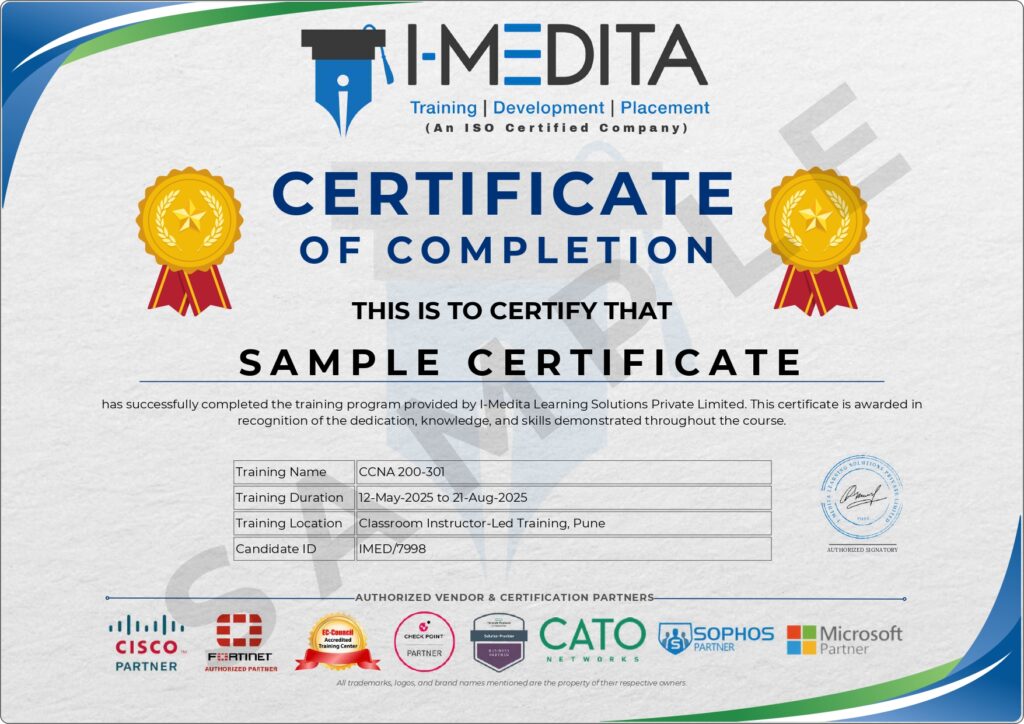
I-Medita Cyber Security Training Certificate
Issued upon successful course completion, the I-Medita Cyber Security Training Certificate validates your practical training, hands-on lab experience, and real-world projects completed during the program. It can be shared on LinkedIn, added to your resume, and used to showcase your Cyber Security skills to potential employers.
- Meet your mentors
Learn directly from CCIE-certified
experts
Learn from CCIE-certified experts with hands-on experience in enterprise networking, infrastructure deployment,
and network operations.
and network operations.

CCIE Sec # 37094, PCNSE, CCSE, MCSE
15+ Years of Experience
Baldev Singh

Triple CCIE EI, Security, SP # 46962
15+ Years of Experience
Saurabh Yadav

CCIE # 41212, AWS, PCNSE, CEH, CEI
12+ Years of Experience
Sudhanshu Bhat

CCIE EI # 60346, SDWAN, ENCOR
10+ Years of Experience
Surendra Singh
- Certifications
What sets us apart from other
Cyber Security institutes
A transparent head-to-head comparison so you can make an informed decision.
FEATURE
I-Medita
EC-Council Accredited Training Center
Other institutes
Generic training
EC-Council Accredited
Official Accredited Training
Center
Usually Not
Trainer Level
Industry-certified Cyber Security Trainers
General IT Trainers
Hands-on Labs
80+ Practical Labs with Real Tools
Limited Practical Sessions
Lab Access
24×7 Online Lab Access
Limited Lab Hours
Curriculum
Latest Industry-Aligned Syllabus
Often Outdated
Projects
Real-World Cyber Security Projects & CTFs
Few or No Projects
Security Tools
Kali Linux, Burp Suite, Metasploit, Wireshark, Splunk & More
Limited Tool Exposure
Placement Support
Dedicated Placement Assistance
Basic Guidance
Interview Preparation
Resume, Mock Interviews & Career Support
Limited Support
Doubt Support
1-to-1 Mentor Assistance
Limited Support
Free Demo
Available
Limited or Not Available
OVERALL SCORE
I-MEDITA
10 / 10
OTHERS
3 / 10
Train with certified Cyber Security experts, gain hands-on experience with real-world tools, and prepare confidently for certification and security careers.
Enroll Now →
- Career Growth
Where a Cyber Security Career Can Take You Over the Next 6 Years
Explore common Cyber Security roles, responsibilities, and salary growth opportunities.
0–1 YEAR
SOC Analyst (L1) / Cyber Security Analyst
Security monitoring, log analysis & incident response
Next: CompTIA Security+ / CEH
START
AVG. SALARY IN INDIA
₹3 – 6 LPA
Entry level
AVG. SALARY IN INDIA
₹6 – 10 LPA
+80% growth
1–3 YRS
1–3 YEARS
SOC Analyst (L2) / VAPT Engineer
Vulnerability Assessment, Penetration Testing & Threat Hunting
Next: eJPT / PNPT / CEH Practical
3–6 YEARS
Senior Cyber Security Engineer
Security Operations, Cloud Security & Incident Response
Next: CISSP / OSCP / AWS Security
3–6 YRS
AVG. SALARY IN INDIA
₹10 – 18 LPA
+230% growth
AVG. SALARY IN INDIA
₹18 – 35+ LPA
Up to 6× from entry level
6+ YRS
6+ YEARS
Security Architect / Cyber Security Manager
Enterprise Security Strategy, Governance & Cloud Security Leadership
Next: CISM / CCSP / Leadership Roles
A Great place to learn
and grow
At I-Medita, we’re your launchpad for growth – a place where learning transforms into success.


- Upcoming Batches
Pick a batch that fits your
schedule
Multiple weekday, weekend and fast-track options — both online and offline in
Pune
Pune
| Course | Start Date | Time (IST) | Mode | Type | Enrollment |
|---|---|---|---|---|---|
| CEH v13 + Linux Essentials | August 8, 2026 | 11:00 am - 1:30 pm | Online / Offline | Upcoming | Enroll Now |
| CEH v13 + Linux Essentials | September 19, 2026 | 8:00 am - 10:30 am | Online / Offline | Upcoming | Enroll Now |
- Success Stories
What our placed alumni say
Real words from real students now working at India’s top networking companies
4.9
★★★★★
Based on 1897+ Google Reviews
Google Reviews
RS
Rahul Sharma
2 weeks ago
★★★★★
"Best CCNA training in Pune. CCIE certified trainers with real lab access. Got placed at Infosys within 6 weeks of completing the course!"
Posted on Google
PD
Priya Deshmukh
1 month ago
★★★★★
"24x7 lab access is the real game changer. I practiced on actual Cisco routers every day. Trainers are very patient and knowledgeable."
Posted on Google
AM
Aakash Mehta
3 weeks ago
★★★★★
"Placement team is excellent. Had 3 interviews before finishing the course. The mock interview sessions really helped me crack TCS."
Posted on Google
- FAQs
Everything you wanted to ask
Still have questions? Drop us a query below — we respond within 24 hours
Training Specific
What does the Cyber Security training program cover?
Our Cyber Security course covers networking fundamentals, ethical hacking, Linux, penetration testing, web application security, vulnerability assessment, SIEM, SOC operations, cloud security, and incident response with extensive hands-on labs.
Will I get hands-on practical experience?
Yes. You’ll practice on real-world labs, virtual machines, Kali Linux, Windows servers, Active Directory, firewalls, and vulnerable applications in a safe lab environment.
Is the course suitable for beginners?
Yes. The course starts from the basics and gradually covers advanced cyber security concepts, making it ideal for beginners and career switchers.
Are interview preparation and mock tests included?
Yes. The course includes technical interview preparation, mock interviews, aptitude guidance, and certification-oriented practice tests.
Will this course prepare me for industry certifications?
Yes. The curriculum is designed to prepare you for globally recognized certifications like CEH, CompTIA Security+, Cisco CyberOps, and more.
Time & Mode
How long is the Cyber Security course?
The training is approximately 120–150 hours and can typically be completed within 4–6 months depending on your batch.
What batch options are available?
Weekday, weekend, evening, and fast-track batches are available. New batches start regularly.
Is the course available online and offline?
Yes. You can attend classes at our Baner, Pune campus or join live online sessions from anywhere.
Which language is used during training?
Training is conducted in English with Hindi explanations whenever required for better understanding.
Can I attend missed sessions?
Yes. You can attend missed topics in another batch and access recorded sessions for revision.
Prerequisites
Do I need an IT background?
No. Anyone with basic computer knowledge can join the course.
Should I learn anything before joining?
No prior cyber security knowledge is required. We teach everything from the fundamentals.
Is this course suitable for non-IT professionals?
Yes. Many students from non-IT backgrounds successfully transition into cyber security careers after completing the course.
Placement
Is placement assistance included?
Yes. We provide resume building, LinkedIn optimization, mock interviews, HR preparation, job alerts, and placement assistance.
Which companies hire Cyber Security professionals?
Our students work in companies such as TCS, Infosys, Wipro, Accenture, Capgemini, HCL, Tech Mahindra, Deloitte, EY, PwC, IBM, and many more.
What salary can I expect after this course?
Freshers typically earn ₹3–6 LPA. With experience and certifications, salaries can grow significantly.
Is placement guaranteed?
We provide dedicated placement assistance, but final selection depends on your skills, performance, and interview results.
Payment
What is the course fee?
Please contact our admissions team for the latest course fee, discounts, and ongoing offers.
Are EMI options available?
Yes. Easy EMI options are available through our finance partners.
Do you offer a free demo class?
Yes. You can attend a free live demo session before enrollment.
Is the course fee refundable?
Please refer to our Refund Policy and Terms & Conditions. We recommend attending the free demo before enrollment.
Which payment methods do you accept?
We accept UPI, debit cards, credit cards, net banking, cash, EMI, wallets, cheques, demand drafts, and PayPal.
Certificate
Will I receive a certificate after completing the course?
Yes. You will receive an I-Medita Course Completion Certificate after successfully completing the training.
Is the I-Medita certificate recognized?
Yes. Our certificate validates your practical skills and is recognized by our hiring partners across India.
Which certifications can I prepare for after this course?
The training helps prepare you for certifications such as CEH, CompTIA Security+, Cisco CyberOps Associate, and other industry-recognized cyber security certifications.
How soon will I receive my certificate?
Your certificate is generally issued within 7 days after successful course completion.
Need Assistance
Whom do I contact for course-related queries?
Call us at +91 95956 09000 (Mon–Sat, 9 AM – 8 PM) or email info@imedita.com. You can also use the assistance form below — we respond within 24 hours.
Can I visit the institute before enrolling?
Yes — walk into our Baner, Pune campus any working day between 10 AM – 7 PM. Address: 2nd & 3rd Floor, Aditi Samruddhi Building, Baner Road, Baner, Pune 411045.
I'm confused about choosing the right Cyber Security course. Can someone guide me?
Absolutely. Book a free counseling session or demo class, and our experts will recommend the best learning path based on your career goals.
- NEED FURTHER ASSISTANCE?
Get Personalized Guidance Before You Enroll
Get in touch with our team for personalized guidance on course content, batches, fees, certifications, and career opportunities.
- +91 8750004411
- info@imedita.com
- 3rd Floor, Aditi Samruddhi Building, Baner Road, Baner, Pune - 411045

Popular 100% Job Guaranteed Programs
Popular Network Security Programs
Popular Trending Courses
- Cisco CCNA Certification Training
- Cisco SD-Access Training
- Cisco CCNP Enterprise Certification Training
- Cisco CCIE Enterprise Certification Training
- Cisco ENARSI Certification Training
- Cisco CCNP Security Certification Training
- Cisco CCIE Security Certification Training
- AWS Certification Training
- CEH Certification Training
- Cisco SD-WAN Certification Training
- Palo Alto PCNSE Certification Training
- Checkpoint CCSE Certification Training
- F5 Load Balancer Certification Training
Trending Free Resources
Address
2nd Floor, Aditi Samruddhi Building,
Baner Road, Baner, Pune – 411 045, Maharashtra, India
Landmark: Near Baner Welcome Board.
2nd Floor, Aditi Samruddhi Building,
Baner Road, Baner, Pune – 411 045, Maharashtra, India
Landmark: Near Baner Welcome Board.
© 2026-2027 – I-Medita Learning Solutions. All Rights Reserved. The certification names are the trademarks of their respective owners.